F848DF31-EA9A-45BE-802A-07B4F53304F9.jpg "Continuous Stirred Tank Reactor (CSTR)")

F848DF31-EA9A-45BE-802A-07B4F53304F9.jpg "Continuous Stirred Tank Reactor (CSTR)")
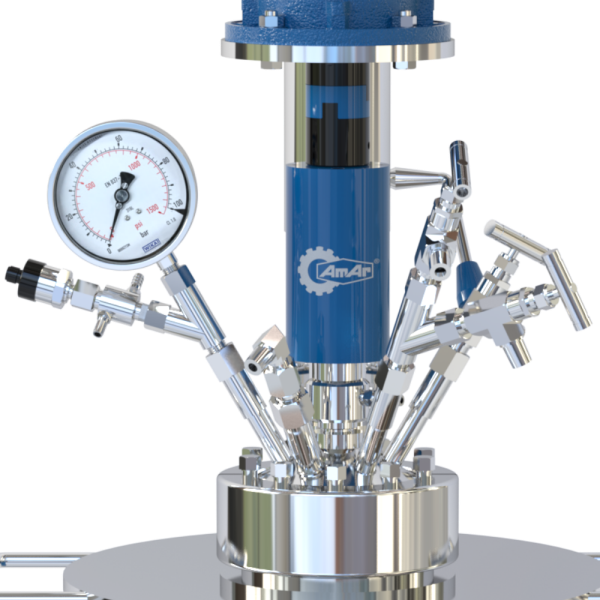
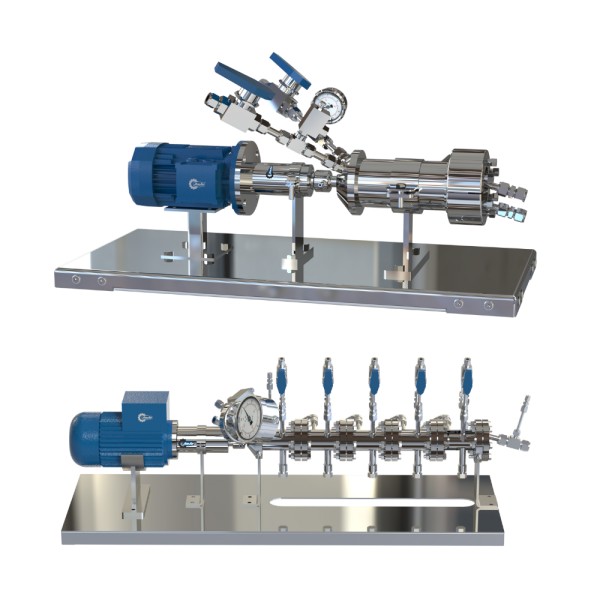
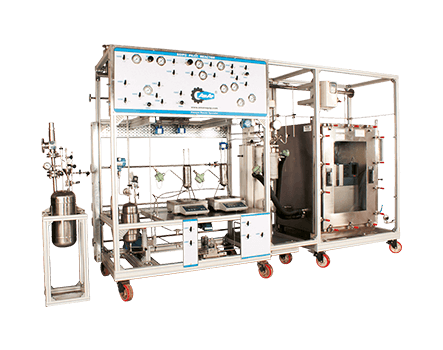
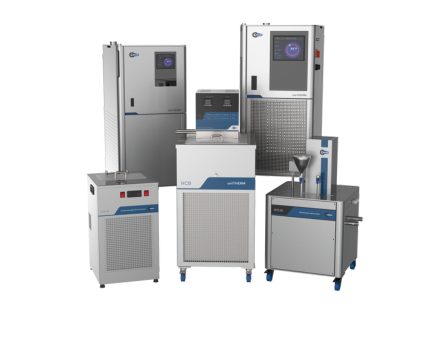
The Continuous Stirred Tank Reactor (CSTR) is designed for steady-state continuous processing where uniform mixing, precise temperature control, and reproducible reaction performance are critical. Available from 100 mL to 1,000 L, with operating conditions up to 350 bar and 500°C, the system is suitable for laboratory, pilot, and production-scale applications. Its multi-reactor cascade configuration enables operation in series or parallel, offering flexibility for residence time control, improved heat and mass transfer, and plug-flow-like behavior when required. The reactor is especially well suited for gas–liquid, liquid–liquid, and slurry systems, making it useful for hydrogenation, oxidation, polymerization, crystallization, fermentation, and related processes. Delivered as a compact, skid-mounted, automated system, the CSTR supports reliable scale-up, safer operation, and consistent continuous manufacturing performance across a wide range of chemical and biochemical applications.
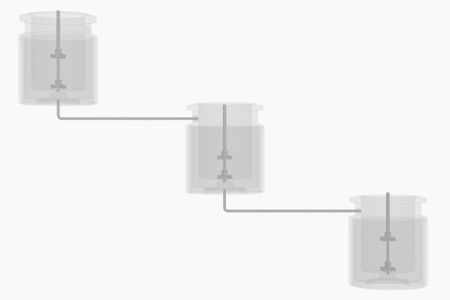
Supports series and parallel cascade arrangements, enabling plug-flow-like behavior or increased throughput based on process requirements.
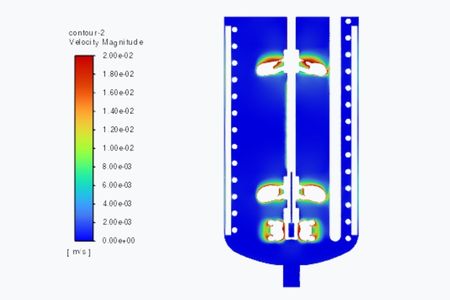
High-efficiency agitation ensures uniform suspension of solids and effective gas dispersion, making CSTRs ideal for slurry and gas–liquid reactions.
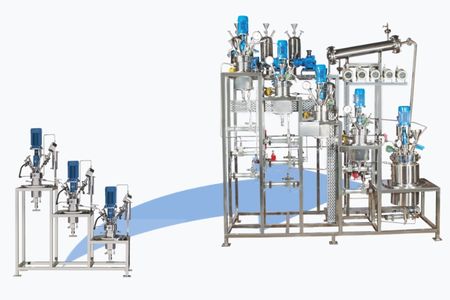
Modular skid-based design allows seamless scale-up from laboratory and pilot units to full-scale continuous production systems.
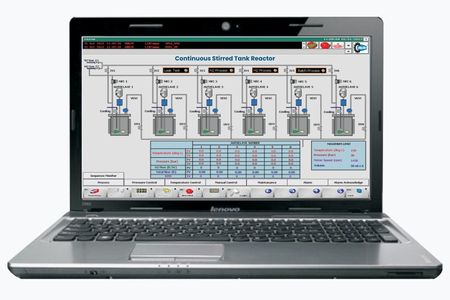
Equipped with PLC, SCADA, instrumentation, and safety systems for reliable, repeatable, and operator-friendly continuous operation.


Start with your target throughput and the residence time your reaction needs, because residence time is simply reactor volume divided by volumetric flow rate. For example, a reaction that needs 30 minutes at a feed rate of 2 L/h calls for roughly a 1 L working volume. Amar's continuous stirred tank reactors are available from 100 mL to 1,000 L, so the same design approach can cover lab development, pilot runs, and production. It is usually best to confirm kinetics on a small CSTR first and then scale volume while keeping residence time and mixing conditions comparable. If you share your flow rate, residence time, pressure, temperature, and phase (gas, liquid, or solids), the Amar team can recommend a suitable size and configuration.
Stirred tank reactors are the better choice when your process involves solids, gas–liquid mixing, high viscosity, or strong heat release, because the agitator keeps contents uniform and the vessel handles heat transfer well. Tubular reactors are usually preferred for fast, homogeneous reactions where a narrow residence time distribution matters most. The trade-off is that a single CSTR needs more volume than a tubular reactor to reach the same conversion for most reactions, which is why continuous stirred reactors are often arranged in a cascade. If you are unsure, a lab-scale CSTR cascade lets you compare performance before committing to a larger system.
Narrow tubular channels clog easily when solids are present, but an agitated tank has an open volume where the impeller keeps solids suspended and moving. To avoid fouling, match the impeller type and agitation speed to your particle size, density, and solids loading, and make sure feed and discharge lines are sized for slurry flow. Stable temperature control also helps, because deposits often form where local cooling occurs near walls or coils. Alarms and interlocks in the PLC/SCADA package can flag abnormal pressure or agitation readings before a blockage develops. Telling the Amar team your solids content, particle size, and viscosity helps them design stirred tank reactors that run reliably with your slurry.
A CSTR typically needs about three to five residence times of continuous feed before outlet composition and temperature stabilize. A common start-up is to fill the reactor with solvent or feed, bring it to the target temperature and agitation speed, and then start the feeds at the set flow rates. Product collected during this period is usually diverted or recycled until readings are stable. With PLC, HMI, and SCADA data logging, you can watch temperature, pressure, and feed rates and confirm steady state before taking samples. Shutdown follows the reverse order: stop the feeds, flush the system, and cool it down under controlled conditions.