Magnetic Drive Couplings are advanced seal-less agitation systems designed to transmit torque from a motor to a reactor impeller using magnetic force, eliminating the need for conventional mechanical seals. In this system, an external magnet rotor connected to the motor drives an internal rotor through a stationary containment shell, allowing the agitator shaft inside the reactor to rotate without any physical shaft penetration. This design ensures completely leak-free operation, making it ideal for high-pressure, high-vacuum, and hazardous chemical processes where leakage or contamination cannot be tolerated.
Magnetic drive couplings are widely used in laboratory, pilot, and industrial reactors for applications such as hydrogenation, polymerization, catalyst studies, and vacuum distillation. They offer high torque transmission, smooth and vibration-free operation, and significantly lower maintenance compared to traditional sealing systems. By eliminating seal wear and leakage risks, magnetic drive couplings improve process safety, product purity, and long-term operational reliability.
| Specs. | Model | Type | Static Torque Capacity | Standard Pressure | Image | 3D | Enquire |
|---|

Magnetic drive couplings are specialized agitation systems used to transmit rotational torque from a motor to an impeller inside a reactor without direct mechanical contact between the drive and the shaft. Instead of using traditional mechanical seals or gland packing, the torque is transmitted through powerful permanent magnets arranged in inner and outer rotors.
These systems are widely used in chemical, pharmaceutical, petrochemical, and research industries where processes involve hazardous, toxic, corrosive, or expensive chemicals. Since no shaft penetrates the reactor wall, the system ensures completely leak-free operation even under extreme operating conditions such as high pressure or high vacuum.
Magnetic drive couplings are particularly beneficial in applications such as hydrogenation reactions, catalyst testing, polymerization processes, vacuum distillation, and laboratory research where product contamination or leakage cannot be tolerated. They are suitable for glass reactors, metal autoclaves, fermenters, and pilot-scale processing units.
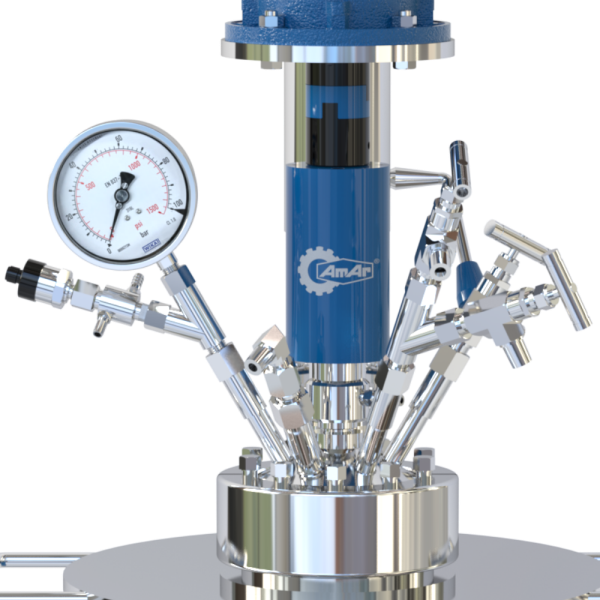
A magnetic drive coupling typically consists of four main components: an external rotor with permanent magnets, an internal rotor with magnets, a stationary containment shell (also called a can or isolation shell), and the reactor agitator shaft connected to the internal rotor.
The external rotor is directly connected to the motor and rotates when the motor operates. Inside the containment shell, a second rotor containing permanent magnets is attached to the agitator shaft. The stationary shell isolates the internal rotor from the external environment and ensures that the process fluid remains completely sealed inside the reactor.
When the external rotor rotates, the magnetic field generated by the magnets causes the internal rotor to rotate synchronously through magnetic attraction. This transfers torque to the agitator shaft without any physical penetration through the reactor wall.
High-energy rare-earth magnets are typically used to achieve strong magnetic coupling and efficient torque transmission. Additionally, a cooling jacket is often provided to remove heat generated during operation and protect the magnets from high temperatures.
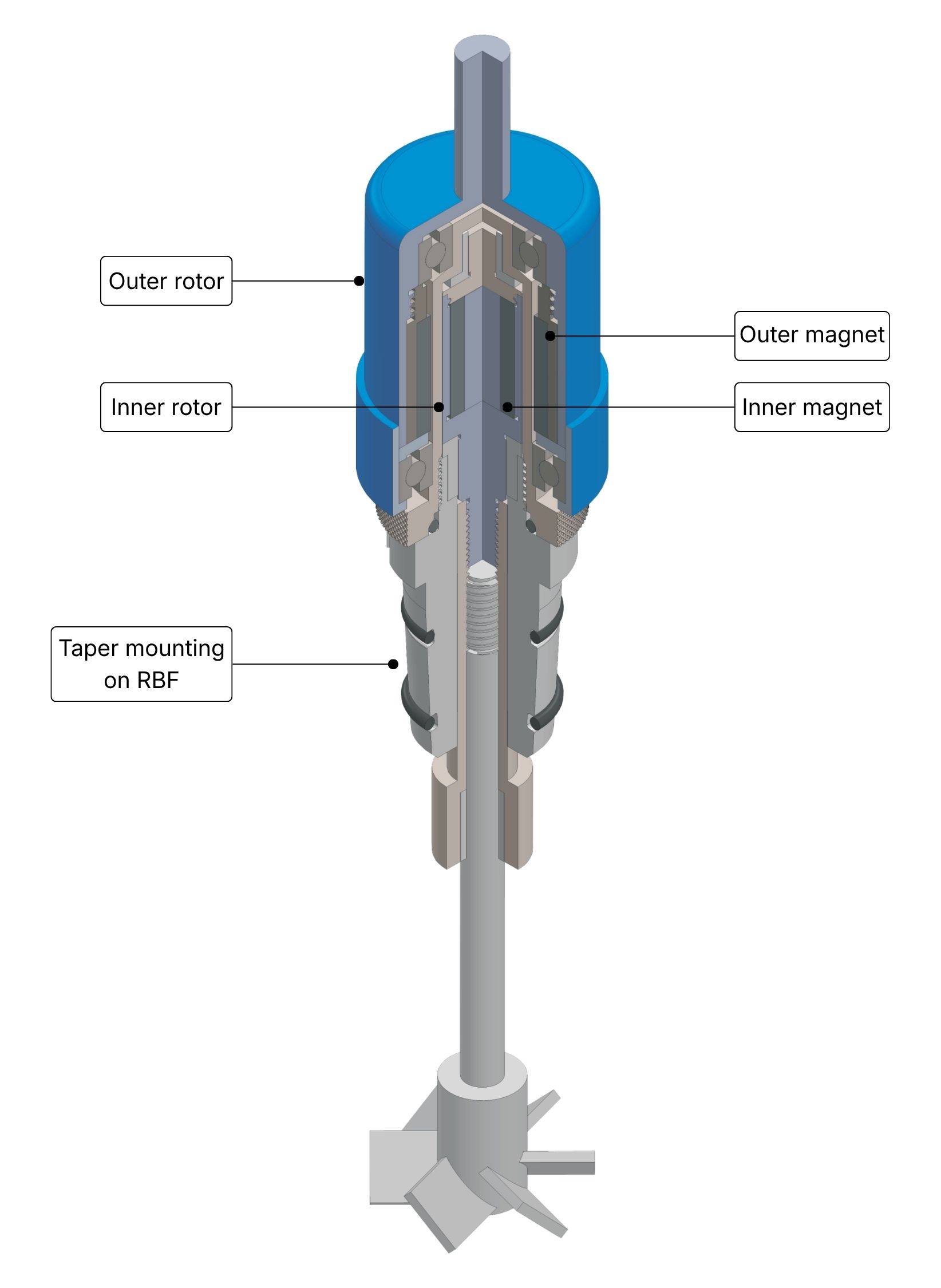
Traditional agitation systems rely on mechanical seals or gland packing to prevent leakage where the shaft enters the reactor. However, these sealing systems experience wear and require periodic replacement, typically after several hundred hours of operation. Leakage from worn seals can result in product loss, contamination, safety hazards, and costly downtime.
Magnetic drive couplings eliminate this issue entirely because there is no shaft penetration into the reactor. This makes the system inherently leak-proof and maintenance-free for extended operating periods.
Another advantage is operational safety. If the system experiences overload or excessive torque, the magnetic coupling can slip instead of damaging the motor or agitator system. Additionally, the absence of friction between sealing surfaces reduces power consumption, vibration, and noise, resulting in smoother and more efficient operation.
Magnetic drive couplings are engineered to operate under demanding process conditions. They can typically function in environments ranging from full vacuum to extremely high pressures of up to approximately 700 bar, depending on the design and reactor configuration.
Torque capacities vary widely, with available magnetic drives ranging from 0.8 Nm to 1000 Nm or higher depending on reactor size, impeller type, and process viscosity. Higher torque models can be custom designed for specialized industrial applications.
Temperature capability depends on materials and cooling design. Systems equipped with cooling jackets can operate at elevated temperatures up to 500°C, ensuring that the magnetic components remain protected from thermal degradation while maintaining reliable torque transmission.
Magnetic drive couplings are designed to support a wide range of reactor sizes and process scales. They are available for small laboratory reactors as small as 50 mL as well as large production reactors up to 10,000 L or more.
Different series are designed for specific reactor configurations. For example, specialized magnetic couplings are available for glass round bottom flasks used in vacuum distillation, while heavy-duty versions are designed for high-pressure metal autoclaves and pilot plant reactors.
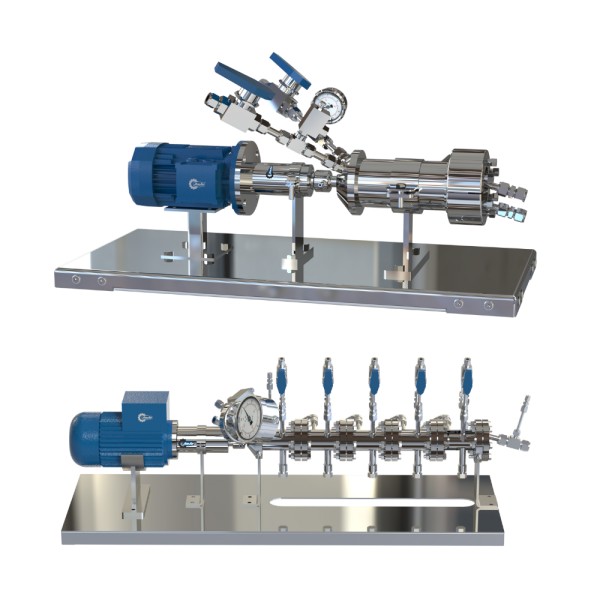
Compact inline motor versions integrate the motor and magnetic drive assembly into a single unit, eliminating the need for separate motors or mounting stands. This makes them particularly useful for laboratory and pilot-scale setups where space efficiency and ease of installation are important.
The material of construction for magnetic drive couplings is selected based on chemical compatibility, corrosion resistance, and operating conditions. The wetted components that come into contact with process fluids are commonly manufactured using high-performance alloys such as SS316 stainless steel, Hastelloy C, Inconel, titanium, or zirconium.
These materials provide excellent resistance to aggressive chemicals, high temperatures, and corrosive process environments commonly encountered in pharmaceutical, fine chemical, and petrochemical industries.
The containment shell and housing are carefully designed to maintain structural integrity under high pressure while ensuring effective magnetic transmission between the internal and external rotors. Material selection also plays a crucial role in maintaining long operational life and preventing contamination of high-purity products.