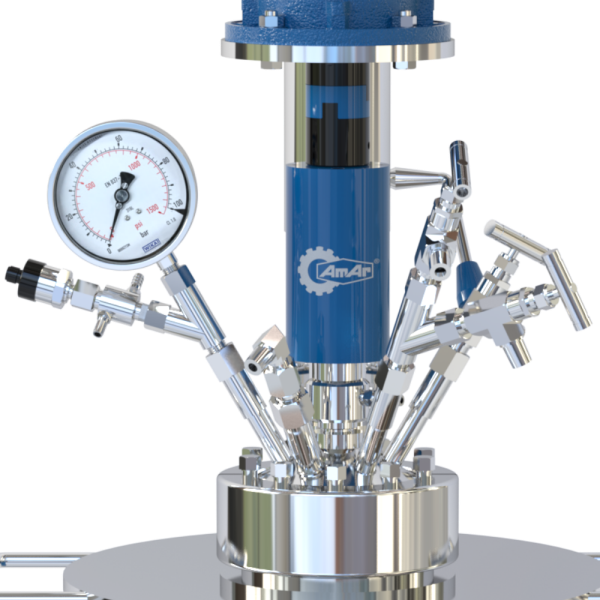
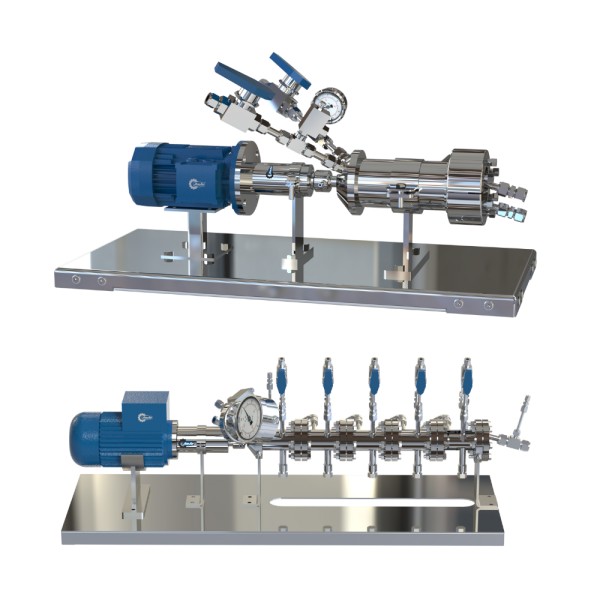
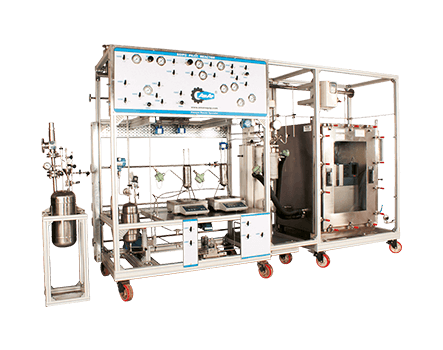
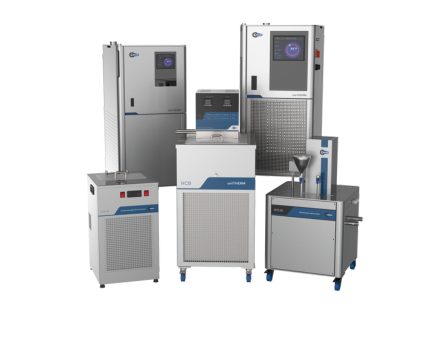
Customized pressure reactors & vessels are engineered for gas–liquid and gas–liquid–solid reactions across 100 L to 1,000 L capacities. Designed for pilot-scale studies, process development, and production applications, these reactors combine high-pressure operation, efficient agitation, and precise temperature control for demanding reaction environments. Built in materials such as SS316, Hastelloy, Titanium, Monel, and Inconel, they are suitable for corrosive and high-temperature chemistries. The systems support batch, semi-batch, or continuous operation, giving users flexibility across a wide range of process requirements. With options for specialized impellers, heating and cooling systems, instrumentation, automation, and skid-mounted assemblies, Our custom reactors can be tailored to specific applications such as hydrogenation, oxidation, carbonation, chlorination, and polymerization, delivering reliable performance, scalability, and safety for advanced industrial and pilot-plant operations.
These reactors are designed for gas–liquid and gas–liquid–solid reactions that require controlled pressure, temperature, and agitation. These are positioned for pilot-scale studies, process development, and production-scale applications across industries such as pharmaceuticals, chemicals, petrochemicals, and specialty materials. Typical processes include hydrogenation, oxidation, carbonation, chlorination, and polymerization.
The reactors are available in a broad range of corrosion-resistant and high-performance materials, including SS316, SS316L, Hastelloy C22, Inconel, Titanium, and Monel. This allows the system to be matched to corrosive chemistries, high-temperature service, and challenging process conditions. Material selection is part of the customization process and depends on solvent compatibility, reactants, and operating conditions.
Yes, customization is one of the main advantages of this product line. Amar states that the reactors can be tailored in terms of agitation system, heating and cooling configuration, instrumentation, automation level, and optional accessories. Options such as baffles, dip tubes, gas spargers, condensers, and sampling ports can also be incorporated. This makes the reactors suitable for highly specific process requirements rather than a one-size-fits-all design.
The reactors use a high-efficiency agitation system to disperse gas into the liquid phase, increasing interfacial area and improving mass transfer. The gas is introduced under controlled pressure and mixed through impeller-generated turbulence, which helps achieve good gas holdup, rapid diffusion, uniform gas dispersion, and reduced dead zones or channeling. This is especially important for multiphase catalytic reactions where reaction rate depends strongly on gas–liquid contact.
Multiple impeller designs are available including Rushton turbines, pitched-blade impellers, and gas-inducing agitators. These can be selected based on the reaction type, viscosity, gas loading, and fluid behavior. The availability of different agitation designs helps optimize mixing, suspension, and mass transfer for each application.
Our systems as suitable for smooth scale-up from lab or pilot work to industrial operation. Their availability in larger working volumes, along with configurable agitation, heat transfer, and automation options, makes them well suited for transferring optimized chemistries into larger-scale manufacturing or pilot plant campaigns.
Our reactors are designed and fabricated in compliance with ASME Section VIII, Div. 1 or PED standards. They can be equipped with precision-engineered closures, safety interlocks, pressure relief devices, and rupture discs for safe containment. Each reactor undergoes hydrostatic testing, NDT inspection, and leak-proof validation to meet international safety expectations.
Yes. The reactors can be fitted with PLC/SCADA-based automation for real-time monitoring, control, and data logging. This improves accuracy, repeatability, and traceability, which is particularly valuable in pilot plants and production environments where consistent operating control is important. Optional skid-mounted assemblies with integrated utilities are also available to simplify installation and operation.