The MicroFLO™ Reactor is a next-generation continuous flow microreactor engineered for high-performance chemical synthesis where safety, scalability, and precision are critical. Built as a compact plate-type microchannel reactor, MicroFLO™ delivers exceptional heat and mass transfer through its patented space-filling architecture with alternating process and utility plates. This design ensures near plug-flow behavior with a narrow residence time distribution, enabling precise control over reaction kinetics and selectivity.
Available in 3D-printed and bolted arrangement, the reactor offers outstanding temperature uniformity and rapid heat dissipation—making it ideal for fast, highly exothermic chemistries such as Grignard reactions, nitration, lithiation, and diazotization. Its modular configuration allows seamless scale-up, ensuring consistent performance from laboratory development to pilot and production scale while maintaining the inherent safety advantages of continuous flow processing.

Engineered to safely handle fast, energy-intensive reactions such as Grignard formation, nitration, and diazotization through rapid heat removal and controlled residence time.
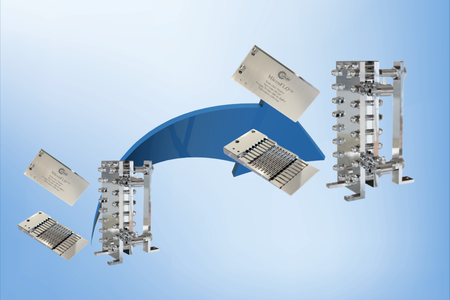
Capacity is increased through numbering-up or larger reactor formats while preserving identical flow geometry, enabling predictable scale-up from lab to pilot and production.

Available in variety of material constructions (including silicon carbide), the reactor can be 3D-printed or given in an openable bolted configurations, allowing easy cleaning, inspection, and maintenance for R&D, multiproduct, and GMP environments.

Diazotization is a commonly used chemical reaction that converts a primary aromatic amine into its corresponding diazonium salt. This reaction serves as a fundamental approach for introducing various functional groups onto the aromatic ring, thereby facilitating the synthesis of a broad range of aromatic derivatives, particularly in the preparation of azo dyes.
Read More


MicroFLO™ is used to run demanding chemistries in continuous flow microreactors where reaction performance depends strongly on controlled mixing, heat removal, and consistent residence time. It is especially useful for reactions that create safety and selectivity issues in batch—such as nitrations, diazotizations, and Grignard chemistry—because the reacting volume is small and conditions are steady rather than changing throughout a batch. Microchannel-based processing also helps improve reaction cleanliness by limiting hot spots and reducing side reactions that are triggered by local overheating or uncontrolled dosing.
MicroFLO™ is a plate-type microchannel reactor designed around a structured flow path and integrated utility plates, so heat exchange happens where it matters—directly adjacent to the reacting channels. Plate-based microstructured reactors are commonly associated with strong plug-flow-like behavior and tight residence time distributions. RTD control is a key differentiator versus many general-purpose small reactors where dispersion can broaden product profiles.
Yes. Microchannel reactors are widely used for multiphase chemistry because microscale flow paths refresh interfacial area efficiently and shorten diffusion lengths. For gas–liquid systems this can mean faster uptake of gaseous reagents; for liquid–liquid systems it supports rapid interphase transport and more consistent contacting. In practice, this is useful for reactions or workups where performance is limited by mass transfer rather than intrinsic kinetics.
MicroFLO™ can be scaled by scale-out (numbering-up) of identical microchannel modules and/or by selecting larger reactor formats (up to 500 mL, as you noted). The advantage of numbering-up is that you preserve the same channel geometry and hydrodynamics—so the “reaction environment” stays consistent while throughput increases. This scale-out approach is frequently highlighted across microreactor technology because it reduces the need to redesign reaction conditions during capacity increases.
Microchannel and plate-type flow reactors are commonly engineered for elevated pressure and temperature service when the metallurgy and sealing strategy are selected appropriately. The practical operating window depends on the exact construction and materials, but the key point is that microstructured designs are chosen when process performance relies on stable operation at defined pressure/temperature targets—particularly for reactions with narrow kinetic windows.
Yes, both the 3D printed and bolted-arrangement reactor are easier to clean. The 3D printed reactor has to be cleaned using a thorough solvent or steam wash. The bolted reactor features an openable plate design that allows easy inspection, cleaning, and maintenance—an important advantage for industrial continuous flow microreactors.
Microreactors and continuous flow microreactors are widely used in pharma and fine/specialty chemicals because they improve reproducibility and enable safer operation for hazardous or fast chemistries. They’re also commonly adopted where process intensification and consistent product quality justify the move from batch to continuous, including scale-up of high-value intermediates and selective transformations.