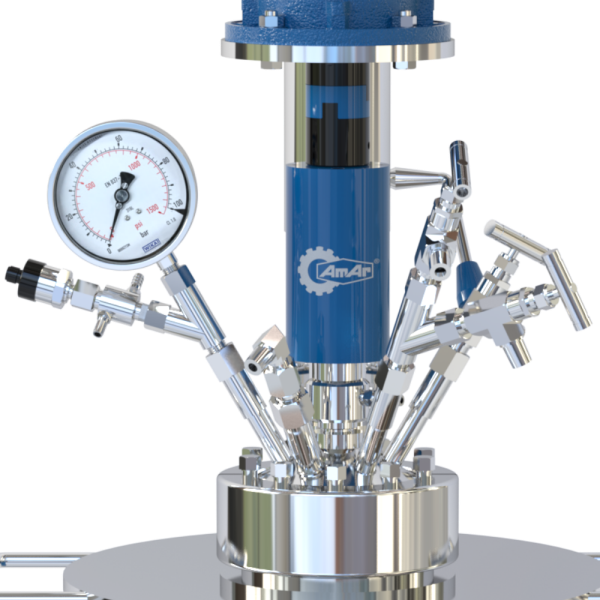
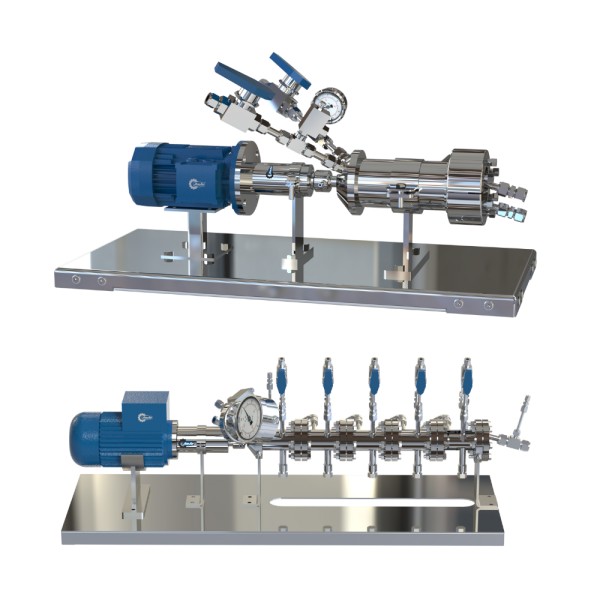
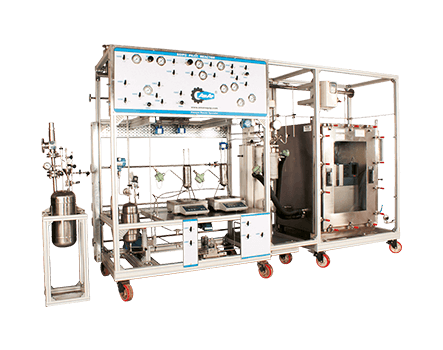
The Shaker Hydrogenator is a compact high-pressure hydrogenation reactor designed for efficient catalytic hydrogenation and other gas–liquid reactions under controlled pressure and temperature conditions. Available in 500 mL to 2 L capacities, with operating conditions up to 20 bar and 200°C, the system is suited for laboratory, pilot, and small-scale production applications. Its dynamic shaking motion promotes rapid and uniform gas–liquid contact, improving hydrogen dispersion, catalyst interaction, and reaction kinetics. Built in SS316, Hastelloy, and glass options, the reactor can be selected based on process compatibility and application needs. With options for manual or automated operation, along with precise temperature control, pressure monitoring, and integrated safety features, the Shaker Hydrogenator delivers reproducible performance, safe operation, and flexibility for hydrogenation process development and optimization across different chemistries and scales.
Our Shaker Hydrogenator is designed for catalytic hydrogenation and other gas–liquid reactions carried out under elevated pressure and temperature. We commonly see it used for hydrogenation, reduction, oxidation, and carbonylation studies in pharmaceuticals, fine chemicals, polymers, petrochemicals, and research laboratories. It is especially useful when customers need a compact and reliable system for process development, catalyst screening, and small-scale production work.
Our system works on the principle of dynamic oscillatory mixing. The reactor is charged with the liquid reactants and catalyst, sealed, and then pressurized with hydrogen or another reactive gas. During operation, the vessel undergoes controlled shaking motion, which continuously renews the gas–liquid interface and improves gas dispersion throughout the reaction mixture. This helps us achieve better catalyst contact, faster hydrogen absorption, and more uniform reaction conditions. We also monitor pressure drop inside the reactor as an indicator of gas uptake and reaction progress.
We use shaking because it provides efficient gas–liquid contact in a compact reactor format. The oscillatory motion improves interfacial renewal and helps distribute gas more uniformly through the liquid phase, which can lead to faster reaction rates and improved mass transfer. For hydrogenation work, this is especially important because reaction performance depends strongly on how effectively hydrogen is dispersed and absorbed. Our shaker design is therefore well suited for applications where consistent gas–liquid interaction is critical.
We offer Shaker Hydrogenators in 500 mL to 2 L capacities, with operating conditions up to 20 bar pressure and 200°C temperature. These specifications make the system suitable for laboratory-scale development as well as pilot and small-scale production applications.
We build our Shaker Hydrogenators as sealed, high-integrity systems for safe high-pressure operation. Our design includes precision-sealed closures, high-pressure-rated fittings, pressure relief valves, rupture discs, and interlocks, and we state compliance with ASME and PED standards. In addition, every Amar autoclave and hydrogenator undergoes hydrostatic testing and quality checks before dispatch, helping us ensure process reliability and operator safety.
Yes. We offer both manual and automated configurations. Our automated systems can include PID temperature control, pressure sensors, and digital data logging for real-time monitoring. We also provide optional SCADA integration for remote monitoring and control, which is especially useful for advanced R&D programs and pilot-scale hydrogenation studies where traceability and repeatability are important.
Yes. We position the Shaker Hydrogenator as a strong platform for generating reproducible results from laboratory to pilot scale. Its controlled gas–liquid mixing, compact sealed design, and available automation help us maintain consistency during process optimization and scale-up studies. It is particularly valuable when customers want to move from exploratory hydrogenation work toward more robust pilot-scale operation without losing process control.