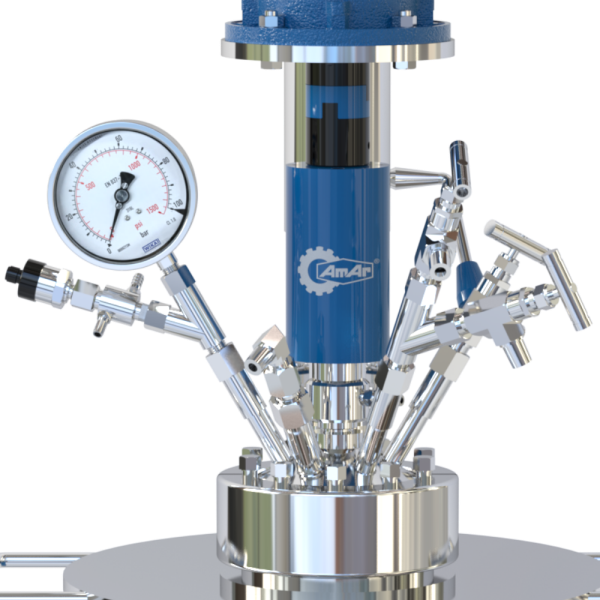
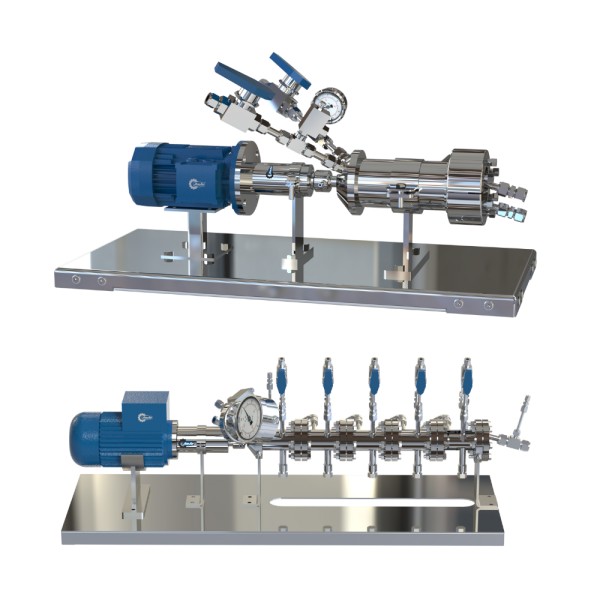
React-7 is Amar’s compact benchtop catalyst screening system designed to deliver reliable and reproducible data through parallel experimentation under controlled pressure and temperature conditions. Engineered for catalyst screening, hydrogenation studies, and kinetic research, React-7 enables scientists to evaluate multiple catalysts and reaction parameters simultaneously within a single, space-efficient platform. This parallel experimentation approach accelerates R&D timelines while maintaining consistent experimental conditions across all reactors.
Each reactor operates with uniform block heating, independent stirring, and precise pressure control, ensuring accurate comparison of catalyst performance under identical thermal and mechanical conditions. With a design pressure capability of up to 100 bar, the system is well suited for hydrogenation and other gas–liquid catalytic reactions. Its robust construction, compact footprint, and advanced safety features make React-7 an efficient and dependable solution for modern catalyst research laboratories.
React-7 is a compact parallel catalyst screening reactor system designed to perform multiple catalyst screening experiments simultaneously under controlled temperature and pressure conditions. The system integrates several small high-pressure reactors into a single benchtop unit, enabling efficient parallel catalyst screening for hydrogenation, catalytic reactions, and kinetic studies.
By allowing researchers to test different catalysts, solvents, additives, and reaction parameters at the same time, React-7 significantly accelerates catalyst screening workflows. This parallel catalyst screening approach improves experimental throughput, enhances data reliability, and helps researchers rapidly identify optimal catalytic systems during early-stage process development.
React-7 is specifically engineered for high-efficiency catalyst screening, enabling multiple reactions to be conducted simultaneously in a controlled and reproducible environment. In conventional catalyst screening workflows, catalysts are evaluated sequentially in a single reactor, which slows down research and process development.
The parallel catalyst screening reactor configuration of React-7 allows several catalyst screening experiments to run in parallel under identical thermal and mechanical conditions. This ensures that differences observed in catalyst activity or selectivity are due to catalyst performance rather than equipment variability. As a result, React-7 significantly reduces catalyst screening timelines and improves the accuracy of catalyst comparison studies.
A parallel catalyst screening reactor such as React-7 supports a wide range of catalytic reactions commonly investigated during catalyst development programs. The system is particularly valuable for gas–liquid catalytic reactionsthat require precise control of pressure, temperature, and agitation.
Typical catalyst screening experiments include:
These capabilities make React-7 an effective tool for high-throughput catalyst screening and reaction optimization.
Reliable catalyst screening requires identical operating conditions across all experiments. The React-7 parallel catalyst screening reactor achieves this through precision block heating and controlled agitation across each reactor.
All reactors are mounted within a uniform heating block, ensuring consistent temperature across every reaction vessel. This eliminates temperature gradients that could influence catalyst performance during catalyst screening experiments. In addition, each reactor incorporates controlled stirring to maintain effective mixing and mass transfer.
By maintaining consistent temperature, mixing, and pressure conditions across all reactors, React-7 ensures that catalyst screening results are reproducible and directly comparable, which is essential for reliable catalyst performance evaluation.
Many catalytic reactions require elevated pressure and temperature to replicate industrial operating conditions. React-7 is designed as a high-pressure parallel catalyst screening reactor, enabling catalyst screening studies under realistic process conditions.
Each reactor can typically operate at pressures up to approximately 100 bar, making React-7 ideal for hydrogenation catalyst screening and other gas-phase catalytic reactions. The system also features uniform block heating with precise temperature control, ensuring stable and consistent thermal conditions during catalyst screening experiments.
These capabilities allow researchers to conduct high-pressure catalyst screening studies, generating valuable data that can be used to scale catalytic reactions from laboratory screening to pilot-scale reactors.
A parallel catalyst screening reactor such as React-7 dramatically improves catalyst development efficiency by enabling multiple experiments to be conducted simultaneously. Instead of performing catalyst screening experiments sequentially, researchers can test several catalysts or reaction conditions in a single experimental run.
This parallel catalyst screening approach provides several advantages:
By enabling high-throughput catalyst screening, React-7 helps research laboratories accelerate catalyst discovery and process development.
React-7 reactors are manufactured using high-strength corrosion-resistant materials to ensure compatibility with demanding catalyst screening reactions. Stainless Steel 316L is typically used as the standard material because of its excellent corrosion resistance and mechanical strength under high pressure.
For specialized catalyst screening applications involving aggressive chemical environments, reactors can also be fabricated using advanced alloys such as Hastelloy, Inconel, or Monel. These materials provide superior resistance to corrosion and chemical attack during hydrogenation and other catalytic processes.
The availability of multiple material options allows the React-7 parallel catalyst screening reactor to safely perform catalyst screening experiments across a wide range of chemical reactions and research applications.