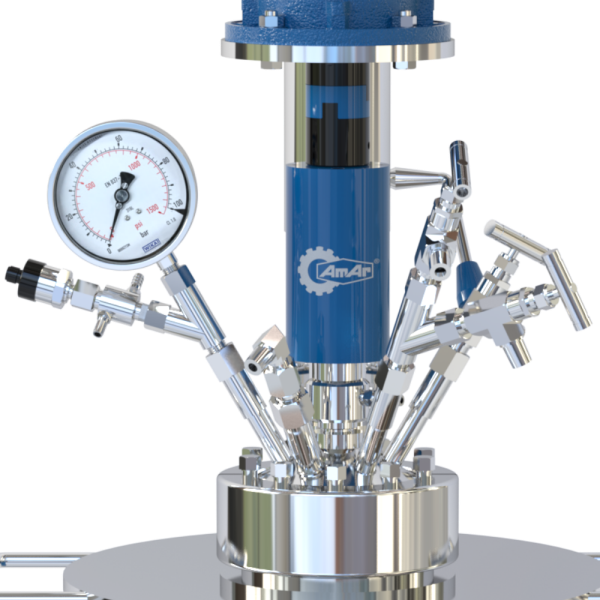
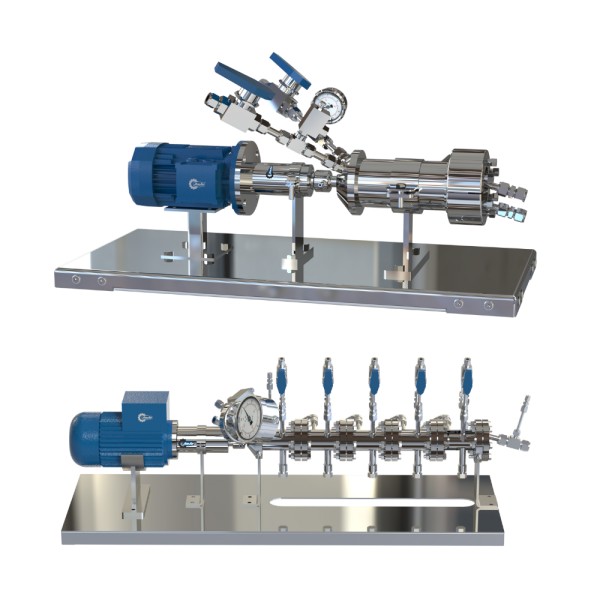
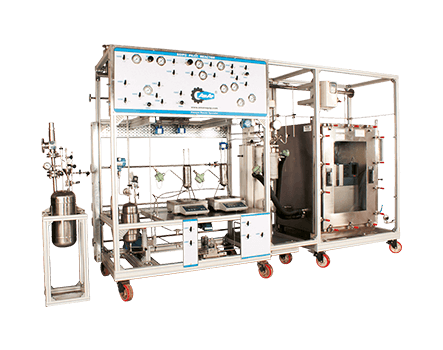
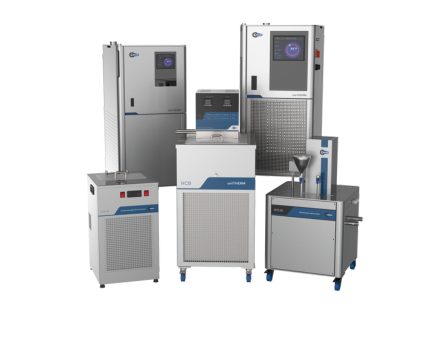
The Amar Continuous Liquid–Liquid Extractor (CLLE) is designed for efficient continuous extraction of immiscible liquid phases in flow chemistry processes. Unlike traditional batch extraction methods such as separatory funnels, the CLLE enables steady-state mass transfer between two liquid phases, improving extraction efficiency and process reproducibility. The system is engineered to provide intense mixing followed by controlled phase disengagement, ensuring effective transfer of target compounds between phases. Its compact and modular design allows seamless integration with upstream and downstream continuous flow equipment, enabling streamlined workflows from reaction to extraction and purification. The CLLE is particularly useful for biphasic reactions, solvent extraction, aqueous workups, and purification steps in chemical and pharmaceutical process development. By operating in a continuous format, the system enhances process efficiency, reduces manual handling, and improves scalability for laboratory, pilot, and continuous manufacturing applications.
A Continuous Liquid–Liquid Extractor is a device used to transfer a solute from one liquid phase to another immiscible liquid phase under continuous flow conditions. In many chemical processes, a compound dissolved in one solvent must be extracted into another solvent to remove impurities or isolate the desired product. The CLLE performs this extraction continuously, allowing the process stream to flow through the system while extraction occurs inline. This makes it well suited for integration into continuous flow chemistry processes where traditional batch extraction methods would interrupt the workflow.
The CLLE operates by bringing two immiscible liquid phases—typically an organic phase and an aqueous phase—into close contact under controlled mixing conditions. This promotes efficient mass transfer of the target compound from one phase to the other. After sufficient mixing, the system allows the two phases to disengage and separate, enabling the enriched phase to be collected separately. Because the process operates continuously, fresh feed streams enter the extractor while separated streams exit, maintaining a steady-state extraction process.
Continuous extraction offers several advantages compared to traditional batch extraction methods such as separatory funnels or mixer-settlers. It improves process consistency and reproducibility, reduces manual handling, and allows integration into automated workflows. Continuous systems also reduce hold-up volumes, improve safety when handling hazardous chemicals, and enable easier scale-up from laboratory experiments to pilot-scale processing. Additionally, continuous extraction can improve extraction efficiency by maintaining optimal mixing and contact between phases.
The CLLE is particularly useful in processes that require liquid–liquid extraction as part of downstream processing. Common applications include purification of reaction products, removal of by-products or impurities, solvent exchange, and aqueous workups following chemical synthesis. It is widely used in pharmaceutical, fine chemical, and specialty chemical process development, especially in continuous flow manufacturing environments.
Yes. The CLLE is designed to integrate seamlessly with upstream flow reactors and downstream separation units. When used together with Amar Equipment’s MicroFLO™ reactor, PinchFLO™ reactor, CorFLO® reactor, or other flow reactor systems, the extractor enables a fully continuous workflow from reaction through extraction and purification. This integration improves overall process efficiency and supports automated operation.
Yes. The Continuous Liquid–Liquid Extractor is designed to operate across a range of flow rates, making it suitable for laboratory process development as well as pilot-scale studies. Researchers can optimize extraction conditions at a small scale and then translate those conditions to larger continuous systems.
Yes. The CLLE is engineered to provide controlled mixing and phase disengagement, allowing it to handle a variety of liquid–liquid systems. It can be configured to work with different solvents, phase ratios, and operating conditions, making it suitable for many chemical processes where efficient extraction is required.