09 Sep 2026

A customized reactor platform for controlled catalyst development, high-pressure gas-phase chemistry, and carbon-utilization research.
APPLICATION SNAPSHOT
Designed for catalytic studies involving CO2, CO and H2, with integrated gas dosing, feed preheating, high-pressure reaction, pressure control, cooling and gas-liquid separation.
The transition toward more sustainable chemical manufacturing is creating growing interest in technologies that can convert carbon-containing gases into useful chemicals, fuels and intermediates.
Among the most actively explored areas are catalytic reactions involving CO2, CO and hydrogen. Whether the objective is catalyst development, reaction-condition optimization or evaluation of new carbon-utilization pathways, researchers need a reactor platform that can provide accurate gas dosing, controlled high-pressure operation and reliable temperature management.
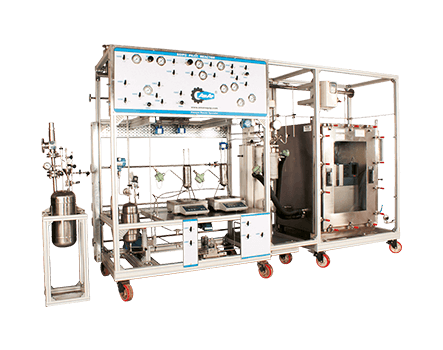
To support such applications, Amar Equipment developed a customized high-pressure fixed-bed reactor system for a customer in Brazil, designed for laboratory-scale catalytic studies.
Catalytic reactions involving gases can be particularly demanding because reaction performance depends on several interconnected variables: gas composition, catalyst-bed temperature, pressure, residence time, feed preheating and product handling.
The reactor system was therefore developed as an integrated experimental platform rather than simply a heated reactor tube. At its core is a 100 mL tubular fixed-bed reactor capable of operating at pressures up to 50 bar and temperatures up to 320°C, providing a practical operating window for high-pressure catalyst studies.
This type of platform can support research in CO2 utilization, syngas chemistry, hydrogenation and heterogeneous catalyst development, where consistent control of the reaction environment is essential for generating meaningful data.
Typical Research Applications
| Application | CO2 hydrogenation studies |
|---|---|
| Research area | Syngas and CO conversion research |
| Catalyst screening | Catalyst screening and comparison |
| Hydrogenation | High-pressure hydrogenation studies |
| Optimization | Reaction-condition optimization |
| Catalysis | Gas-phase heterogeneous catalysis |
One of the key requirements of the application was the ability to work with different gaseous reactants while maintaining controlled flow rates.
The system incorporates dedicated gas-flow control for hydrogen and a flexible line for CO or CO2 when these gases are not required simultaneously. This allows researchers to establish defined feed compositions while keeping the overall setup compact and adaptable.
Special consideration was also given to CO2 handling. A heated catch-pot and line-heating arrangement help maintain suitable feed conditions before the gas enters the reactor.
For meaningful catalyst evaluation, the feed should reach the catalyst bed under controlled thermal conditions. The gas stream therefore passes through a coil-type preheater before entering the reactor.
The reactor is positioned inside a split electrical furnace, while multiple temperature measurement points monitor the process and catalyst region. This configuration is especially useful in catalytic studies where temperature strongly influences conversion, selectivity and catalyst behaviour.
Pressure is another important variable in gas-phase catalytic chemistry. The platform is rated for 50 bar operating pressure with a 60 bar design pressure, enabling researchers to investigate reactions across a substantial high-pressure range.
An automatic back-pressure regulator maintains the required reaction pressure during continuous operation. Pressure measurement, relief devices and high-pressure interlocks are integrated into the system.
The usefulness of a catalytic reactor does not end at the reactor outlet. High-temperature gas-phase reactions can generate both condensable and non-condensable products, so downstream handling is an important part of the experimental setup.
After leaving the catalyst bed, the process stream passes through a spiral condenser and then into a jacketed gas-liquid separator. This allows the reaction mixture to be cooled and the condensed fraction to be separated from the remaining gas stream before sampling and analysis.
By integrating gas feeding, preheating, reaction, pressure control, condensation and separation within one system, the platform provides researchers with a complete workflow for continuous catalytic experimentation.
Research programs evolve. A project may begin by varying temperature and pressure, then move toward different gas ratios, catalyst formulations or residence times. The reactor platform was therefore configured to support changing experimental objectives rather than one narrowly defined test.
An integrated control panel and HMI support monitoring and control of gas flow, temperature and pressure, together with suitable high-temperature and high-pressure alarms and interlocks. This helps researchers focus on understanding the chemistry while the equipment maintains a controlled operating environment.
The growing emphasis on lower-carbon chemical pathways is increasing the importance of technologies capable of converting CO2, CO and hydrogen into useful products. Before these processes can progress toward pilot or commercial scale, catalysts and operating conditions must first be understood under controlled laboratory conditions.
A high-pressure fixed-bed reactor can provide an important bridge between fundamental catalyst research and process development by enabling systematic evaluation of temperature, pressure, gas composition and catalyst performance under continuous-flow conditions.
This application demonstrates the value of engineering the reactor around the chemistry. By combining controlled gas dosing, high-pressure operation, precise heating and integrated product handling, researchers gain a practical platform for turning catalyst concepts into reproducible process-development data.
ENGINEERED AROUND YOUR APPLICATION
Amar Equipment can configure fixed-bed reactor systems around specific feed gases, catalyst requirements, operating pressure, temperature, instrumentation and downstream handling needs.