14 Nov 2026

Engineering an integrated flow platform for controlled vaporization, catalytic conversion, product recovery and analysis
Application Focus: Low-pressure ketonization of a volatile fatty-acid feed using controlled gas and liquid feeding, vaporization/preheating, a heated fixed catalyst bed, condensation, gas-liquid separation and a downstream GC connection.
Volatile fatty acids are increasingly being explored as renewable building blocks for the production of higher-value chemicals and fuels. Produced from biological and waste-derived feedstocks, these organic acids create an opportunity to move from low-value carbon streams toward more useful chemical intermediates.
One important pathway for upgrading these molecules is ketonization.
For catalyst developers and process researchers, however, carrying out ketonization continuously is not simply a matter of passing a liquid through a heated reactor. The feed has to be accurately delivered, vaporized, mixed with the required gas stream, brought to reaction temperature, contacted with the catalyst and then cooled and separated for analysis.
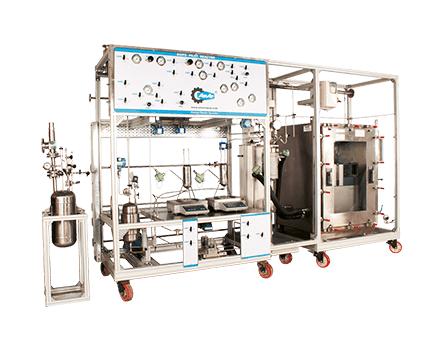
Amar Equipment recently developed a customized fixed-bed reactor system for low-pressure ketonization of volatile fatty acids, bringing all of these functions together in a laboratory-scale platform.
Ketonization provides a route for converting carboxylic acids into larger oxygenated molecules that can serve as intermediates for further chemical upgrading.
For researchers working with biologically derived volatile fatty acids, this creates an interesting pathway between fermentation-derived molecules and downstream fuels or chemicals.
In this application, the liquid feed consisted of a mixture of volatile fatty acids, including valeric, caproic, heptanoic and caprylic acids, together with smaller quantities of butyric acid.
Unlike a conventional single-component feed, such mixtures introduce several practical challenges. The components have different boiling characteristics, the mixture becomes increasingly corrosive at elevated temperatures, and the complete feed must be transferred reproducibly into the vapour phase before reaching the catalyst.
These requirements influenced the design of the entire reactor system.
The first challenge is delivering the fatty-acid mixture consistently. A dedicated liquid-feed vessel and HPLC pump provide controlled introduction of the feed into the system. From there, the liquid enters a heated vaporization section.
This step is particularly important for volatile fatty-acid chemistry. Feeding partially vaporized material directly into the catalyst bed could lead to uneven catalyst wetting, unstable residence time and inconsistent reaction performance.
The system therefore uses a dedicated vaporizer and preheater arrangement to convert the liquid feed into a controlled vapour stream and bring it closer to reaction temperature before it reaches the catalyst.
CO2 and N2 can be introduced through controlled gas-feed lines, allowing the researcher to establish the desired reaction environment and study catalyst behaviour under different operating conditions.
At the centre of the system is a tubular fixed-bed reactor installed inside an electrical furnace. For the ketonization application, the reactor is designed for operation up to approximately 550°C, providing the thermal window required for catalyst screening and process-condition optimization.
The fixed-bed arrangement allows a defined quantity of catalyst to remain stationary while the conditioned feed continuously passes through it. This makes the platform particularly useful for studying:
Instead of performing isolated batch experiments, researchers can observe catalyst behaviour under continuous conditions that are more representative of future process operation.
The project also demonstrates why feed properties must be considered early in reactor design. The volatile fatty-acid mixture begins boiling at elevated temperature and becomes more corrosive as temperature increases. During development of the system, particular attention was therefore given to the heated feed section, reactor materials and downstream equipment.
Material selection must balance chemical compatibility, operating conditions, campaign duration, equipment cost and the actual requirements of the research programme.
What happens after the reactor is just as important as what happens inside it. The hot reactor outlet can contain condensable reaction products, unreacted feed and non-condensable gases. The system therefore incorporates downstream cooling followed by gas-liquid separation.
A specially configured condenser cools the reactor effluent before it enters a jacketed gas-liquid separator. The condensed liquid fraction can then be collected for further characterization, while the remaining gas stream can continue toward analytical equipment.
For this application, the system architecture also provides an outlet toward gas chromatography, enabling researchers to connect reaction experiments directly with analytical measurements.
This combination of reaction and downstream handling creates a more complete process-development platform rather than simply a standalone reactor.
Continuous high-temperature operation with volatile organic feeds requires more than temperature control alone. The reactor system incorporates monitoring and interlocks for important operating parameters.
A low-level condition in the feed vessel can trip the liquid pump, while high-temperature and high-pressure conditions can trigger protective actions. Temperature monitoring is provided around critical heated sections, and a dedicated safety switch protects the furnace against over-temperature conditions.
These measures help ensure that experimental flexibility does not come at the expense of operational protection.
Perhaps the most important part of this project was not any individual component. It was the process of adapting the system as the application became better understood.
Gas-flow requirements were revised. Vessel sizes were optimized. The pressure-control philosophy was simplified when atmospheric operation was confirmed. Different heating approaches were evaluated. Material selection was reviewed against corrosion, cost and campaign requirements. Analytical connections were repositioned based on the intended experimental workflow.
The final result was therefore not a standard fixed-bed reactor taken from a catalogue. It was a reaction platform engineered around the ketonization experiment.
Developing new routes from renewable and biologically derived feedstocks requires the ability to move beyond proof-of-concept chemistry. Researchers need equipment that allows them to understand catalyst performance, optimize reaction conditions, study stability and generate reproducible continuous-process data.
For volatile fatty-acid ketonization, that means integrating the complete experimental sequence within one coordinated system:
| Controlled liquid feeding | Vaporization & gas addition | Fixed-bed reaction | Condensation & separation |
|---|---|---|---|
| Stable feed delivery | Conditioned vapour feed | Catalyst screening & optimization | Product recovery & GC analysis |
This project demonstrates how a customized fixed-bed reactor can provide the bridge between catalyst development and continuous process development, helping researchers evaluate how renewable carbon streams can be transformed into the next generation of chemicals and fuels.